
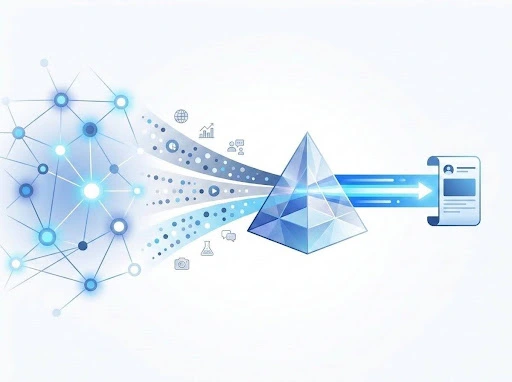
For many people, the first news of the day no longer comes from a newspaper, television bulletin or news website. It comes from a phone. A notification appears, a video starts playing, someone we follow posts a breaking update, an influencer discusses an issue, a friend shares a screenshot, or a short clip appears on our feed with thousands of comments underneath it. Before we have consciously decided what we want to know, an algorithm has already begun deciding what we are likely to see. This has fundamentally changed our relationship with news and information. The question is no longer simply, “What news is being published?” We also need to ask: Who or what is deciding which news reaches me?
The Invisible Editor
Traditional news organisations have editors. An editor decides which story appears on the front page, which headline deserves prominence and which stories receive less attention. Social media platforms have something different: recommendation systems and algorithms that personalise content based on signals such as engagement, viewing behaviour and other interactions. The result is a personalised information environment. Two people sitting next to each other can open the same platform and see completely different versions of what is happening in the world. One person may see political content, another may see celebrity news, a third may see fitness videos, while a fourth may see posts about a particular social issue. None of these feeds necessarily represents the entire information environment. They are selections, and selections influence perception.
The Feed Is Not a Mirror of Reality
One of the most important media literacy lessons today is that our social media feed is not a neutral representation of the world. It is a filtered environment. This can be difficult to notice because the feed feels natural. We open an app, scroll and see one post after another. Because the experience is continuous, we may assume that we are simply seeing what is happening. But we are not. We are seeing what the platform has selected for us. That distinction matters. If someone repeatedly encounters videos about a particular conspiracy theory, they may begin to think that the theory is extremely widespread. If another person never encounters those videos, they may have no idea that the theory exists. Both users can come away with very different impressions of public opinion, and neither necessarily has a complete picture.
Echo Chambers and Filter Bubbles
Two terms often appear in discussions about personalised information: echo chambers and filter bubbles. An echo chamber describes an environment where people primarily encounter opinions that reinforce one another. A filter bubble refers more broadly to the way personalised systems can limit or shape the information a person encounters. These concepts are related but not identical. The important point is that repeated exposure can create a feeling of consensus. Imagine opening your social media feed and seeing twenty posts making the same argument. After a while, the argument may begin to feel obvious. You might think, “Everyone knows this.” But your feed may simply be showing you more of the same type of content because you have interacted with it before. The platform is responding to your behaviour, and you are then responding to the platform. It becomes a feedback loop.
Engagement Is Not the Same as Importance
Social media platforms are extremely good at identifying content that attracts attention. But attention and importance are not always the same thing. A misleading post may receive more engagement than a carefully researched article because it provokes anger or amusement. A sensational video may outperform a detailed explanation. A controversial statement may generate thousands of comments, while an important public health update may receive very little engagement. This creates an important media literacy distinction: popular does not necessarily mean important, and important does not necessarily mean popular. When users confuse the two, their understanding of the world can become distorted.
The Power of Repetition
There is another subtle effect: repetition. When we encounter the same claim repeatedly, it can begin to feel familiar. Familiarity can sometimes be mistaken for truth. A person may see a particular claim in a WhatsApp group, then encounter it on Instagram, then hear someone mention it in a video. The claim now appears to be everywhere. But these may not be three independent sources. They may all be repeating the same original post. This is why media literacy requires us to distinguish between multiple mentions and multiple sources. Ten accounts repeating the same unverified claim do not provide ten pieces of evidence. They may provide only one unsupported claim repeated ten times.
Influencers Are Becoming Information Gatekeepers
The traditional distinction between journalism and commentary has become increasingly blurred. Influencers, creators and online personalities often discuss politics, health, science, finance, current affairs and social issues. Their audiences may trust them more than traditional media organisations. There is nothing inherently wrong with this. Creators can explain complex subjects in accessible language and bring attention to issues that traditional media may overlook. But influence is not the same as expertise. A person can have millions of followers and still be wrong about a subject.
Media literacy therefore requires audiences to ask several questions. What is this person’s expertise? Are they presenting evidence? Are they distinguishing fact from opinion? Do they disclose commercial interests? Are they willing to correct mistakes? These questions are useful whether the information comes from a journalist, politician, influencer or friend.
The Problem With Screenshots
Screenshots have become one of the most common forms of digital evidence. A screenshot of a tweet, news article or government notice can appear convincing. But screenshots remove context. They can be cropped, edited, or presented without the surrounding conversation. Dates can disappear, usernames can be changed or misrepresented, and a genuine statement can be presented alongside a false caption. This is why a screenshot should usually be treated as a lead, not the final proof. If an important claim is based on a screenshot, look for the original post or document. The original source may reveal information that the screenshot does not show.
How Algorithms Can Amplify Misinformation
Algorithms do not necessarily need to “believe” misinformation to help it spread. They respond to user behaviour. If misleading content receives strong engagement, it may receive more visibility. This can create a difficult situation. Imagine a sensational false claim receives thousands of comments because people are angry about it. The engagement itself becomes a signal. The content attracts more attention, more people see it, more people react, and more engagement follows. The cycle continues.
This does not mean that every viral false claim was deliberately amplified by a platform or that algorithms are solely responsible for misinformation. It means that the design of digital platforms can influence the conditions under which information spreads. Understanding that system is part of being media literate.
Breaking Out of the Bubble
The good news is that users are not completely powerless. One of the simplest ways to improve your information diet is to deliberately diversify your sources. Don’t rely on a single social media platform for news. Follow journalists or organisations with different perspectives. Read beyond headlines. Visit original sources. Look for primary documents where possible. If an issue matters to you, actively search for credible information rather than waiting for your algorithm to bring it to you.
This changes the relationship between the user and the platform. Instead of asking the algorithm, “What should I know today?”, you begin asking yourself, “What do I need to know, and where can I find reliable information about it?” That is a powerful shift.
Media Literacy Is Also About Understanding Ourselves
It is easy to blame algorithms. But algorithms work partly because they learn from us. Every like, comment, share, search, follow and viewing decision provides information about what captures our attention. This means that media literacy has an internal component. We need to understand our own information habits.
What kind of content makes us angry? What makes us anxious? Which accounts do we automatically trust? Which opinions do we reject without reading? When do we usually consume news? Do we read beyond headlines? Do we verify information that supports our beliefs as carefully as information that challenges them? These are not just technical questions. They are questions about how we think.
The Future of News Will Be More Personal
Personalised information is not going away. In fact, it is likely to become even more sophisticated. Artificial intelligence will increasingly help platforms understand what individual users want to watch, read and hear. This could make information more accessible, but it could also make information environments more fragmented. Two people may eventually receive dramatically different versions of the same day’s news. That makes a shared understanding of basic facts more difficult.
A democratic society depends, at least to some degree, on citizens having access to reliable information about the world around them. If every person exists inside a completely different information environment, disagreement can become more difficult to resolve.
Building a Healthier Information Diet
Just as people talk about eating a balanced diet, we should begin thinking about having a balanced information diet. A healthy information diet might include multiple credible news sources, primary documents when available, local and national reporting, expert voices relevant to specialised subjects, different perspectives, fact-checking organisations, long-form reporting rather than only short videos, and time away from constant notifications and breaking news.
The objective is not to consume more information. It is to consume better information. More content does not automatically produce more knowledge. Sometimes it produces more confusion.
The New Definition of Being Informed
Being informed today does not mean knowing everything that is trending. It means having enough awareness to distinguish between what deserves attention and what merely demands it. A person can spend hours scrolling through current affairs content and still have a poor understanding of an issue. Another person might read two reliable reports, check the original source and understand the context. The second person may have consumed less content but gained more knowledge.
That is why media literacy is becoming essential. We are no longer living in a world where information is scarce and access to it is the primary challenge. We are living in a world where information is abundant, immediate and increasingly personalised. The challenge is deciding what deserves our attention.
The algorithm can recommend. It can rank. It can personalise. But it cannot replace our responsibility as users. We still have to ask questions. We still have to check sources. We still have to recognise our own biases. And sometimes, we have to step outside the comfortable world our feed has built for us. Because being informed is not simply about seeing more. It is about seeing beyond what is placed in front of us.