
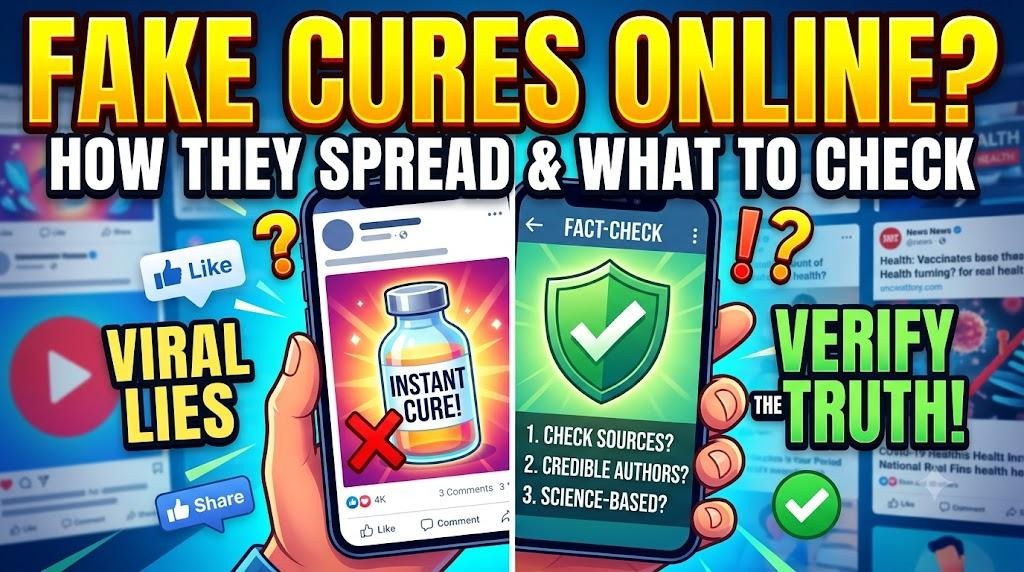
When a “Miracle Cure” Appears on Your Feed
A video claims that drinking a particular herbal mixture can permanently cure diabetes. Another post says that a certain food can “destroy cancer cells” within days. A WhatsApp message promises that a homemade remedy can cure a serious illness without medicines or medical treatment. Such claims can sound hopeful, especially when they are presented as a personal success story. But a convincing story is not the same as medical evidence.
False medical cures are a form of health misinformation in which unverified, exaggerated or scientifically unsupported claims are presented as effective treatments for diseases or health conditions. Social media has made it easier for such claims to reach thousands of people within minutes, often without any information about where the claim originated or whether it has been medically tested.
Example: “A Simple Remedy Can Cure Diabetes”
Consider a social media post claiming: “Boil these three leaves, drink the water every morning and your diabetes will be completely cured. Doctors don’t want you to know this secret.”
At first glance, the post may appear believable. It might include photographs of healthy-looking people, a video of someone claiming their blood sugar improved, or comments from users saying the remedy “worked for them.” It may even use medical terminology to sound authoritative.
But several questions immediately arise: Was the remedy tested in properly designed clinical trials? Was the claim published in a credible medical journal? Can the result be independently reproduced? Is there evidence that the remedy treats the underlying disease rather than temporarily changing one symptom or measurement?
Without reliable evidence, an individual testimonial cannot establish that a treatment cures a disease.
Why Do People Believe These Claims?
False medical cures often work because they appeal to emotions. People who are worried about their health may naturally look for simple, affordable and accessible solutions. A claim that promises a quick cure can therefore be much more attractive than the reality of managing a chronic or serious illness.
Scammers and misinformation creators may also use phrases such as “miracle cure,” “100% guaranteed,” “secret remedy,” “doctors won’t tell you,” or “cure in seven days.” These phrases create urgency and make the information appear like a hidden discovery rather than an unsupported claim.
The popularity of a post can also create a false sense of credibility. Thousands of views, shares or comments do not prove that a medical claim is true.
A Personal Story Is Not Medical Evidence
One of the most common techniques used to promote false cures is the testimonial.
A person may say, “I used this remedy and my condition disappeared.” Their experience may be genuine, but it does not prove that the remedy caused the improvement. Symptoms can change naturally, several treatments may have been used at the same time, or the original diagnosis may have been incorrect.
This is why medical research relies on systematic evidence rather than individual experiences. A treatment needs to be studied carefully to determine whether it is actually effective and whether its benefits outweigh potential risks.
Watch Out for “Natural Means Safe”
Another misleading idea is that something must be safe because it is described as natural, herbal or traditional.
Natural substances can have biological effects, interact with medicines or cause harmful side effects. Some products sold as “natural cures” may also contain undisclosed ingredients or inaccurate doses.
The important question is not whether a treatment is natural or synthetic. The important question is whether there is credible evidence that it is safe and effective for the condition being treated.
The Biggest Risk: Delaying Proper Treatment
False medical cures are not simply a matter of believing incorrect information. They can have real-world consequences.
A person who believes that a serious illness can be cured with an unproven remedy may delay consulting a qualified healthcare professional, stop prescribed medication or spend money on products that offer no proven benefit.
For conditions such as cancer, diabetes, heart disease or serious infections, delaying appropriate medical care can be particularly dangerous. Even when a remedy itself appears harmless, using it as a replacement for evidence-based treatment can create serious risks.
How we Fact-Check a Medical Claim
Before believing or sharing a health claim online, we start with the source. Is the information coming from a qualified medical professional, a recognised health institution or a peer-reviewed scientific publication? Or is it coming from an anonymous social media account selling a product?
Next, we search for the claim independently. We do not rely only on the websites or videos promoting the treatment. Look for information from reputable medical and public-health organisations and check whether credible scientific studies support the claim.
Pay close attention to the language being used. A claim promising a “100% cure,” “instant result” or “permanent cure for every patient” should immediately make you cautious. Real medical treatments generally have limitations, risks and varying outcomes.
Check the Evidence, Not Just the Comments
Comments and testimonials can make misinformation look convincing. Someone may write, “It worked for me,” while another person may claim that their relative was cured.
But comments are not a substitute for clinical evidence.
When evaluating a medical claim, ask whether there are credible studies supporting it and whether those studies actually investigated the disease and treatment being discussed. Also check whether the information has been independently reviewed or reported by trusted medical institutions.
A useful media literacy habit is to separate “someone says it worked” from “there is evidence that it works.” These are two very different statements.
Be Careful When Money Is Involved
False medical claims frequently overlap with health scams. Be especially cautious when the person making the claim is also trying to sell you a product, consultation, subscription or “secret treatment.”
A seller may create fear around conventional medicine while presenting their own product as the only solution. Claims that discourage patients from consulting doctors or suggest that medical professionals are hiding a cure are major warning signs.
Never make a health decision solely because a product is heavily promoted online or because it has received thousands of views.
The Media Literacy Lesson: Hope Needs Evidence
Health misinformation can be particularly powerful because it often targets something deeply personal: our desire to stay healthy or see someone we love get better.
That is why media literacy matters. Being media literate does not mean automatically rejecting every traditional remedy or believing everything said by a medical professional online. It means knowing how to question, verify and evaluate information before acting on it.
The next time you see a post promising a miracle cure, stop before sharing it. Ask: Who is making the claim? What evidence supports it? Has it been independently verified? Could following this advice cause harm?
When it comes to health, a viral video is not a clinical trial, a testimonial is not proof and thousands of shares do not turn misinformation into medical fact.
Before you trust a cure, check the evidence. Your health is too important to experiment with an unverified claim.