By the time you stop to ask whether it is true, the message may already be moving through someone else’s WhatsApp group.
Your phone lights up with a WhatsApp notification in your family group.
“For public relief, Indian government is offering free LPG cylinders. To claim the offer, click the link below. Send this to everyone.”
You are not sure if it is true. Because it looks too good to be true but too tempting to ignore. So you do what millions of people do every day.
Tap share, select all, forward.
Within minutes, the message moves from your family group to a housing society group, then to an office chat, and from there into several other local groups. By the time someone checks whether the offer is genuine, the original message may have gone much further than anyone expected.
Why did you forward something you were not even sure was real?
Of course, you did not want to spread a rumour. You were not trying to deceive anyone. You may even have added “Please check if this is true” before sending it. You simply received something that seemed possibly useful or important, and acted before stopping to verify it.
Psychologists say that believing something and sharing it are two different actions. You do not have to be convinced that a message is true before sharing it along. So why do we do it?
Then why do we do it?
The first trigger is raw emotion. Viral messages designed to trigger panic, anger, curiosity, or a sudden sense of urgency.
A warning about child kidnappers in your city makes you anxious. A message about a health emergency makes you worried. A post claiming that a particular group has done something terrible makes you angry. A government benefit that expires “today” creates the fear of missing out.
Once you feel that urgency, checking the claim can become secondary.
Researchers Soroush Vosoughi, Deb Roy and Sinan Aral analysed millions of posts shared on X (Twitter) and found that false news travelled farther and faster than true news.
False stories were also more likely to contain new information and provoke emotional reactions such as surprise, fear and disgust.
There is a practical reason this matters. If a message simply says, “The government has changed the eligibility rules for LPG subsidies,” you may read it and move on.
If it says, “URGENT: Your subsidy will be cancelled unless you complete this form TODAY,” you are much more likely to do something with it. The message has already told you what to feel before you have had a chance to ask whether it is true.
The Trust Filter
On WhatsApp, messages usually come with people we know. Your mother sends it. Your uncle sends it. A colleague sends it. Someone you have known for years sends it to the group.
You trust the person, so you are less likely to question the information they have shared. That does not mean you think they personally verified it. You simply make a quick judgement: They would not knowingly send me something false.
The problem is that trust in a person is not evidence for a claim. Your uncle can be completely trustworthy and still forward a completely false message because he received it from someone he trusts. The message effectively borrows credibility from the person who sends it.
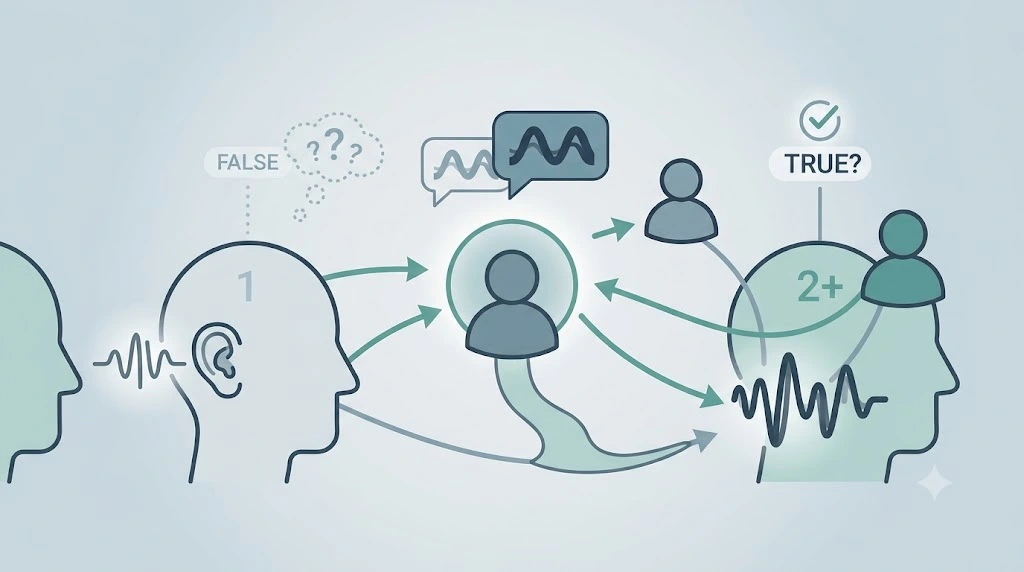
This becomes even more powerful inside private groups. If five people you know have already shared the same claim, it can start to feel as though five people have independently confirmed it. In reality, all five may have received it from the same original source.
Hearing Something Twice Makes It Real
You see a message in your family group and ignore it. The next day, the same claim appears in your housing society group. Later, a friend sends you a screenshot of it. Nothing about the claim has changed. You still do not know where it came from. But it feels different now because you have seen it before.
Psychologists call this the Illusory Truth Effect. Repeated exposure can make information feel more familiar, and that familiarity can influence how believable it seems.
Research by Gordon Pennycook, Tyrone Cannon and David Rand has found that even a single exposure to a false headline can affect how people judge the headline when they encounter it later. Repetition can make the claim easier to process, and that ease can be mistaken for evidence.
This is one reason a false message does not need to convince you on the first try. It can simply keep appearing.
The first time, you think: That sounds ridiculous.
The third time, you think: I have heard this before.
Those are very different reactions, even though the evidence has not changed.
The “Just in Case” Mindset
Most people who forward an unverified message are not thinking about misinformation at all. They are thinking about helping someone.
What if this is actually true? Better to warn people. Let them decide for themselves. It cannot hurt to share.
That last assumption is where things can go wrong.
A false warning about a kidnapping can frighten parents. A fake health claim can change someone’s behaviour. A fraudulent government-scheme message can lead people to a scam website. Even when the sender has good intentions, the consequences can be real.
Pennycook’s research points to another part of the problem: people can care about truth and still fail to consider accuracy when deciding to share something. Attention gets pulled towards what is interesting, alarming or useful, while the quieter question of “Is this accurate?” gets left behind.
The problem is not always that people believe everything they see. Sometimes they simply do not stop to think about whether the thing they are sharing is true.
The Design of Private Networks
WhatsApp makes this particularly difficult because much of what happens there takes place inside private groups.
On a public platform, someone can reply to a false post. A journalist might see it. Another user might add evidence. A fact-checker might publish a correction. In a private group, the message can circulate among people who already trust one another, with no outsider present to question it.
And these groups overlap. You send something to your family group. Your cousin sends it to a neighbourhood group. Someone there sends it to a school parents’ group. Another person forwards it to colleagues. The same message keeps entering new circles through people who have no idea where it started.
That is how a message can travel widely without a single person deliberately deciding to create a rumour. Not everyone believes it. Not everyone even trusts it. Enough people simply think, “Maybe.”
Three Questions Before You Click Share
There is no need to fact-check every joke, opinion or ordinary WhatsApp conversation. But a message that asks you to act immediately, promises money, makes a serious accusation or triggers a strong emotional reaction deserves a second look.
Before you forward it, ask yourself:
1. Do I have direct evidence that this is true? Where the claim came from. Is there any evidence beyond the message itself?
2. If it turns out to be false, could someone be harmed by acting on it?
3. Can I spend 30 seconds searching for a reliable source right now?
You might still decide to share it. But at least then, you are sharing it because you checked, not because your thumb got there first.
A rumour can cross a hundred phones in the time it takes one person to verify it. That is why sometimes the most useful thing you can do with a suspicious message is very simple: Pause. Check. Know. Share.