Artificial intelligence is making it easier to create convincing fake videos, voices and images of public figures. As synthetic media enters political communication and everyday news consumption, media literacy and independent verification are becoming essential.
Deepfakes have changed the way audiences must evaluate digital evidence. A video of a politician, an audio recording of a public figure, or an image of a breaking event can no longer be considered authentic simply because it looks or sounds convincing. India’s experience with AI-assisted political communication, combined with documented cases of synthetic content circulating during emergencies and elections, highlights the need for stronger verification practices. However, the scale and real-world impact of AI-generated misinformation must be assessed carefully rather than assumed from individual viral examples.
When seeing is no longer believing
For generations, photographs, audio recordings and videos have played an important role in establishing what happened. A photograph could document an event, a recorded speech could preserve a politician’s words, and a video could help journalists establish a sequence of events. These forms of evidence were never impossible to manipulate, but their production often required specialised skills, equipment or considerable time.
Generative artificial intelligence has changed that equation. Today, tools can generate realistic faces, reproduce voices, alter expressions, translate speech and create scenes that never occurred. Some tools can make a person appear to say something they never said or place a real individual into a fabricated situation.
This technology has legitimate applications in entertainment, accessibility, education and creative production. The problem arises when synthetic content is presented as authentic evidence without disclosure, particularly when it concerns elections, communal tensions, public safety or allegations against individuals.
A convincing video can now be false. Equally, a genuine video can be misleading when it is edited selectively, stripped of context or paired with a fabricated caption. Media literacy must therefore extend beyond identifying artificial images. It must also help people understand how authentic material can be manipulated to communicate a false message.
What research tells us about deepfakes and political misinformation
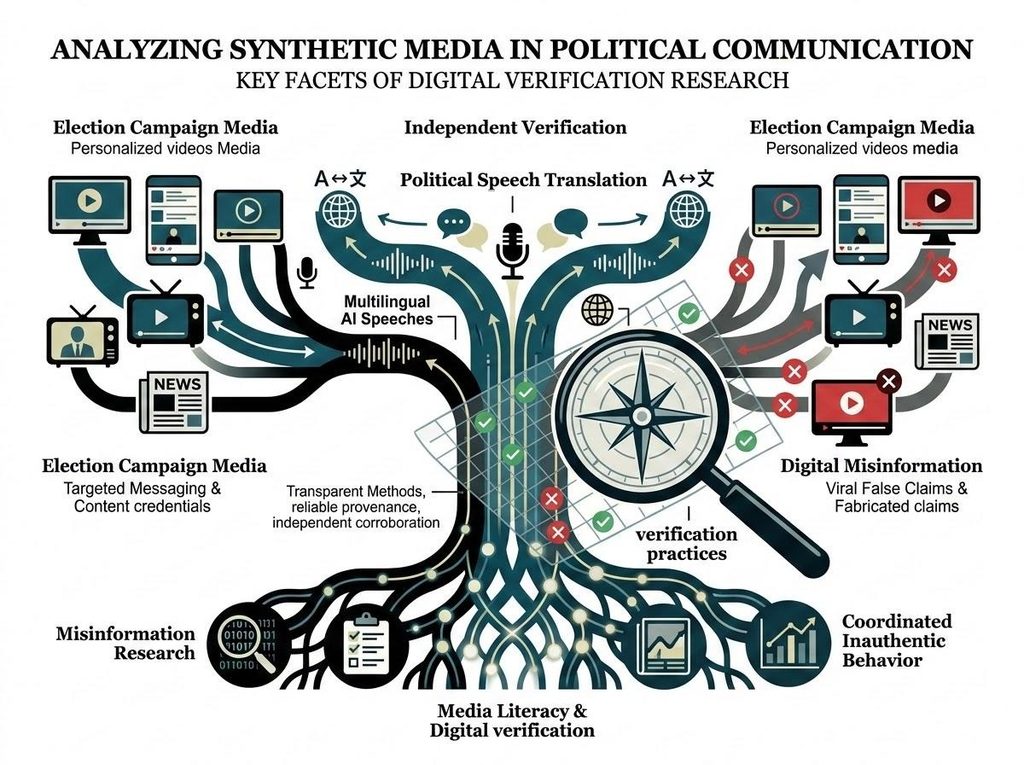
India’s 2024 general election offered an important example of the growing relationship between AI and political communication. In an article published on 19 March 2024, the Reuters Institute for the Study of Journalism examined the use of AI-generated media in the Indian electoral environment. Its reporting described how political campaigns were experimenting with multilingual AI-generated speeches, personalised video messages and lifelike representations of deceased political leaders. It also discussed concerns about synthetic content being used to mislead audiences.
This distinction matters: AI-generated political content is not automatically misinformation. A translated speech or a digitally recreated image can be used transparently for legitimate purposes. The risk depends on how the material is produced, disclosed, distributed and interpreted.
The World Economic Forum’s Global Risks Report 2024 identified misinformation and disinformation as major short-term global risks. India was ranked as the country with the highest perceived exposure to misinformation and disinformation in the report’s country-level assessment. This was a ranking of perceived risk, not a measurement proving that India produces the world’s largest quantity of false content.
International research has also documented the difficulty of identifying the effects of AI-generated misinformation. A 2024 Reuters Institute report on digital news consumption noted growing concern about synthetic images and videos, while highlighting that the extent of people’s exposure and the impact on their beliefs remained uncertain. The existence of convincing deepfakes is established; how much any particular deepfake changes political opinion or electoral behaviour is a separate empirical question.
These findings point to a critical challenge. Public debate often concentrates on spectacular fake videos, but the wider problem includes ordinary misleading posts, selective edits, false attributions and fabricated claims that may circulate alongside genuine news.
How deepfakes can distort political understanding
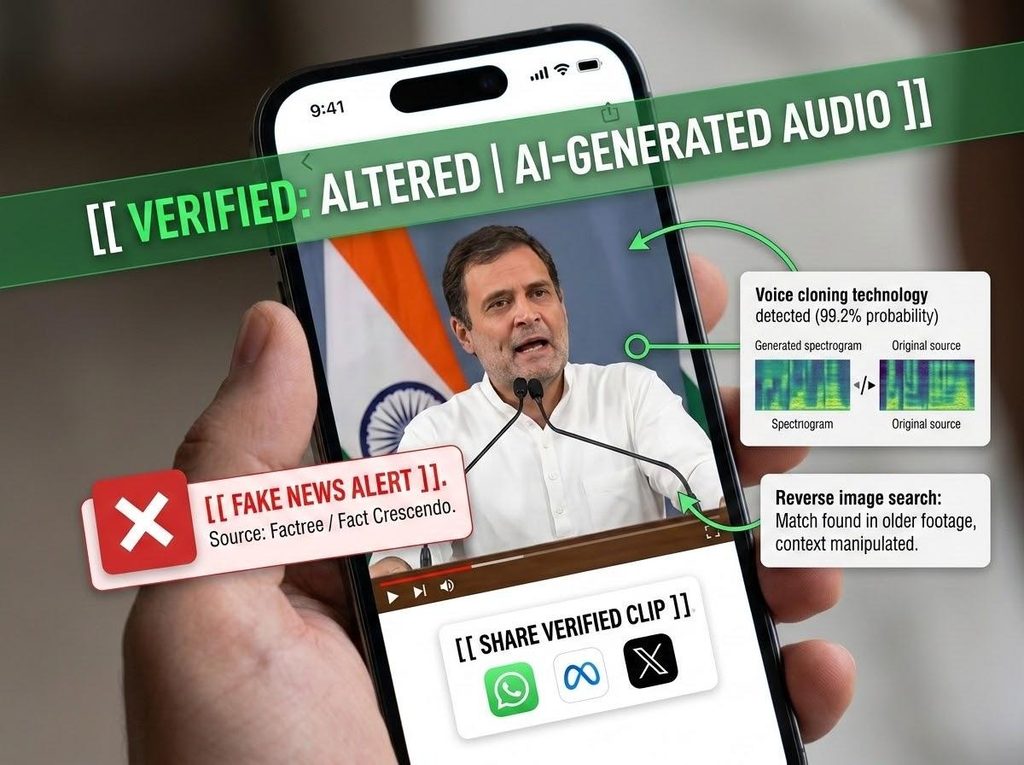
Political misinformation does not need to persuade every viewer that a fabricated event is real. Sometimes, its influence comes from making people uncertain about what they should believe.
Imagine a video circulating during an election that appears to show a candidate making an inflammatory statement. The clip is short, emotionally charged and accompanied by a caption claiming that a major news organisation has confirmed its authenticity. Within minutes, people begin forwarding it to family groups, posting angry reactions and demanding explanations.
There are several possibilities: the video may be entirely AI-generated; it may be an authentic recording with altered audio; it may be a genuine statement from a different occasion; or it may be real but misleadingly edited. Each possibility requires a different verification process.
If the video is fake, the immediate harm may include reputational damage, public anger or the spread of a false allegation. Even after a correction is published, the original clip may continue circulating independently. People who encountered the original post may never see the correction.
A second danger is the erosion of trust in authentic evidence. When synthetic media becomes more common, public figures may dismiss genuine recordings as fabricated. Journalists and fact-checkers can then face a difficult task: establishing the authenticity of real material while audiences have become accustomed to questioning everything.
This does not mean that all digital evidence has lost its value. It means that evidence must be evaluated through transparent methods, reliable provenance and independent corroboration.
Beyond deepfakes: the problem of ordinary manipulation
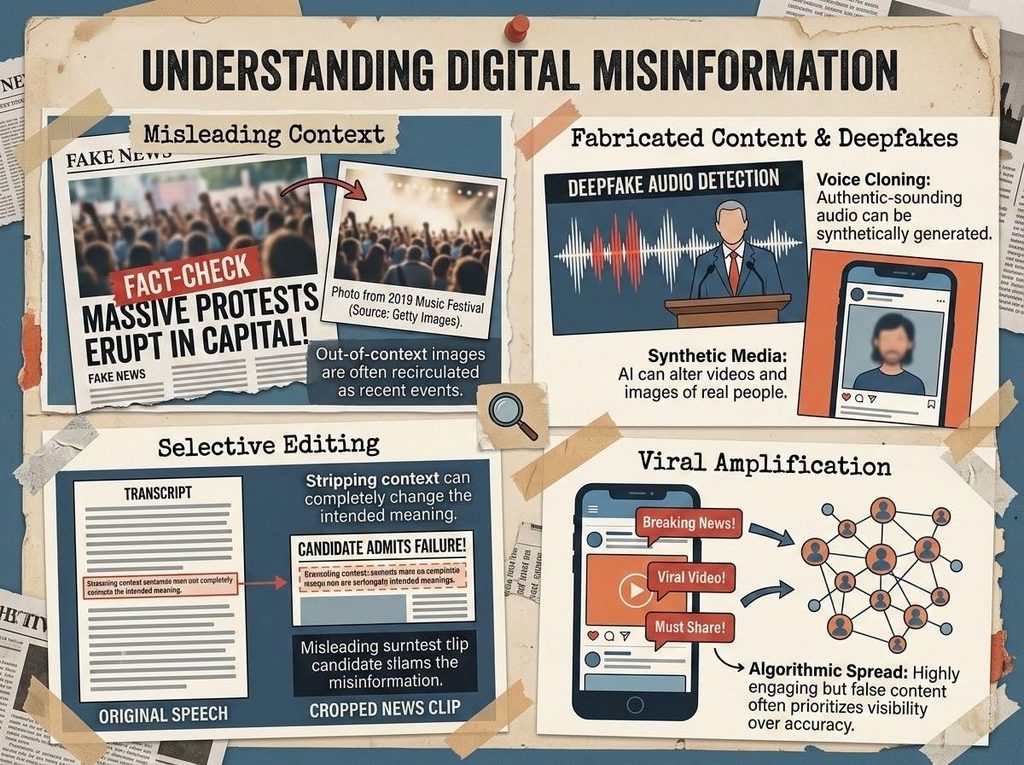
Focusing exclusively on AI can obscure older and often simpler forms of misinformation. A video recorded several years ago can be recirculated as a recent event. A genuine speech can be shortened to remove a qualifying sentence. A photograph from one country can be labelled as an incident in another. A real image can be paired with an invented quotation.
These techniques can be effective because audiences tend to interpret visual material quickly. A familiar face, a recognisable location or an apparently authoritative news graphic can create an immediate impression of credibility.
The lesson is important for fact-checkers: finding no obvious signs of AI manipulation does not prove that a video is authentic or correctly described. Verification must establish both the nature of the media and the accuracy of the claim attached to it.
Similarly, automated AI detectors should not be treated as final authorities. Detection systems can produce false positives and false negatives, particularly when content has been compressed, edited or passed between platforms. Technical indicators may support an investigation, but they should not replace source verification and corroborating evidence.
How to verify a suspicious political video
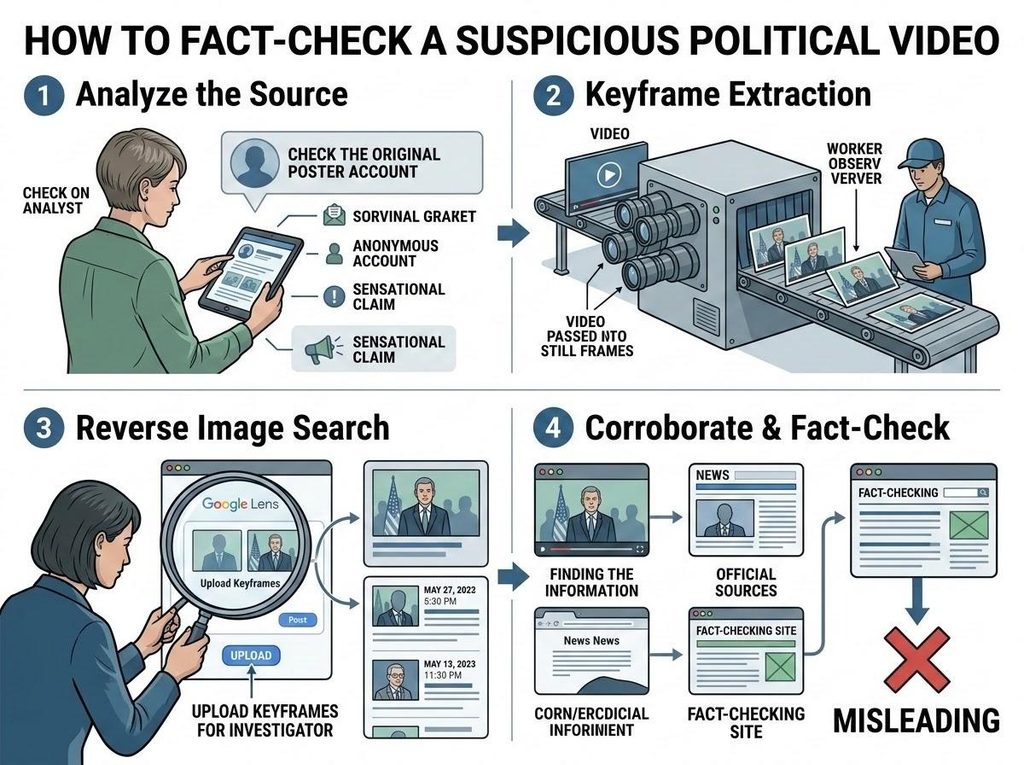
Media literacy becomes useful when it gives people a practical method they can apply before sharing content.
First, identify the original source. Who first published the video or audio? Is the account an official channel, a journalist with a verifiable record, an anonymous page or an account that repeatedly posts sensational material? An account’s identity is a starting point, not proof that a particular post is true.
Second, search for the complete recording. Look for the full speech, interview, press conference or broadcast. Compare the viral clip with the original material and check whether the words, sequence or surrounding context have changed.
Third, use reverse image search and keyframes. Extract distinctive frames from a video and search for earlier versions. A match can reveal that the footage predates the alleged event or appeared under a different description. The earliest version found online is not necessarily the original, so the date and source should be independently assessed.
Fourth, look for independent corroboration. If a major public figure supposedly made a significant announcement, check whether reliable news organisations, official transcripts or the person’s verified channels provide supporting evidence. Absence of coverage is not conclusive by itself, but it may justify further investigation.
Fifth, examine the context rather than relying on visual clues alone. Unnatural lip movements, inconsistent shadows, strange hands or distorted background details may be warning signs. Their absence, however, does not establish authenticity. Voice-cloning technology may also produce convincing audio, so familiar-sounding speech should not be treated as proof of identity.
Finally, be cautious with AI detection tools. Record what a tool indicates, but distinguish a technical assessment from a verified conclusion. Strong fact-checking combines original-source tracing, contextual analysis, expert examination where necessary and corroboration from independent sources.
What should platforms, journalists and educators do?
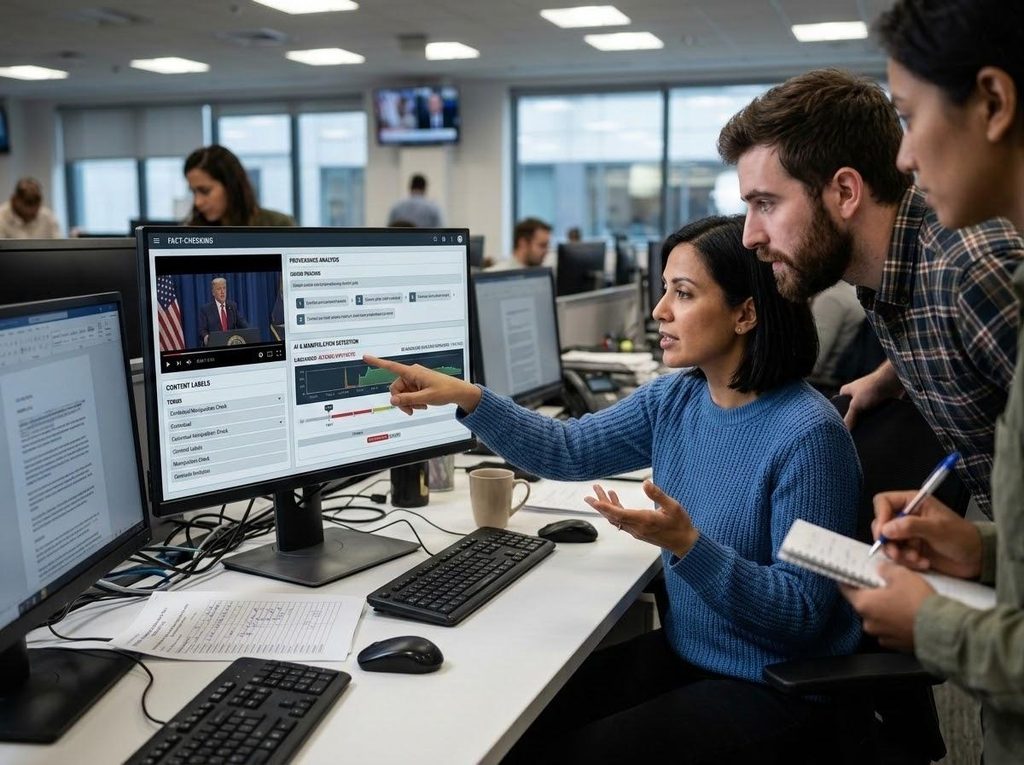
The International Telecommunication Union has called for stronger approaches to detecting and identifying AI-generated deepfakes. In a report covered by Reuters on 11 July 2025, the UN agency emphasised more robust detection measures, content provenance and the development of standards that could help people assess the origins and trustworthiness of digital media.
Provenance information can help establish where content originated and whether it has been altered, although it is not a complete solution. Metadata can be removed, and the presence of a technical label does not automatically establish that the content’s claims are accurate.
Newsrooms should preserve original files where possible, document how material was obtained, verify sensitive recordings before publication and clearly explain the methods used to authenticate them. Platforms can improve the visibility of content credentials and labels, while educational institutions can teach students how to examine sources and distinguish verified evidence from speculation.
Public figures and political organisations also have a responsibility to disclose synthetic media that could reasonably be mistaken for authentic recordings. Transparent labelling helps audiences understand what they are viewing without treating all AI use as inherently deceptive.
For ordinary users, one simple habit can make a difference: pause before forwarding a sensational clip. Ask what it claims, where it originated and what independent evidence supports it.
Conclusion
Deepfakes are not merely a technological problem. They are a challenge to the information habits through which people understand politics, assess public figures and make collective decisions.
The answer is not to reject every video or assume every surprising recording is artificial. Nor is it to trust a clip simply because it looks realistic. The answer is to treat digital content as evidence that must be examined.
In an environment where images, voices and videos can be generated or altered at scale, the most valuable skill is not the ability to spot every visual imperfection. It is the ability to ask the right questions, trace information to its source, seek independent corroboration and withhold judgment when evidence is insufficient.
Media literacy begins when we recognise that seeing something online is the beginning of verification, not the end of it.