Indian government has launched the Money Restoration Module (MRM) to make the process of recovering money lost to online fraud simpler, faster, and easier to track.
You lose money in an online scam. Maybe it was a fake job scam. Or perhaps you clicked on a phishing link and unknowingly approved a payment.
You immediately called the cybercrime helpline 1930 and reported a complaint. The stolen money is frozen before the scammer could withdraw it.
Now the question arises: “How do you get my money back?”
If you’ve ever lost money to an online scam, you know that losing money is only the beginning of the trouble.
Even when stolen money is traced and frozen, getting that money back can be a long, confusing process that involves banks, police, and legal procedures. People often did not know which office to visit, which documents to submit, and how long the refund would take.
To make things easier, the Ministry of Home Affairs (MHA) has launched a new online platform called the Money Restoration Module (MRM) under the National Cyber Crime Reporting Portal.
The goal is clear: Make the process of recovering money lost to online fraud simpler, faster, and easier to track.
What Is the Money Restoration Module (MRM)?
The Money Restoration Module (MRM) is an online system developed by the Indian Cyber Crime Coordination Centre (I4C).
The MRM portal gives victims a simple and transparent way to start money refund process online.
If your stolen money has been successfully frozen in a scammer’s bank account, you may no longer need to run from one office to another to start the refund process.
You can now submit a refund request online through the newly launched Money Restoration Module.
But here’s the fact you should take note: The MRM does not recover money if the criminals have already withdrawn it from the bank accounts.
Who Can Use MRM?
You can use it only in two scenarios.
First, you must have reported the fraud through the 1930 helpline or the National Cyber Crime Reporting Portal and received a 14-digit complaint acknowledgement number.
Second, the stolen money must have been successfully frozen during the investigation. The MRM does not recover money if the criminals have already withdrawn it from the bank accounts.
Suppose, you lose Rs. 30,000 in a fake job scam. You reported the fraud within minutes. The banks froze the amount in the fraudster’s account before they could withdraw it.
In such a case, you may be eligible to request a refund through the portal.
But if the scammer has already withdrawn it, even though a complaint exists, there may be no recoverable money left.
How to Apply for a Refund
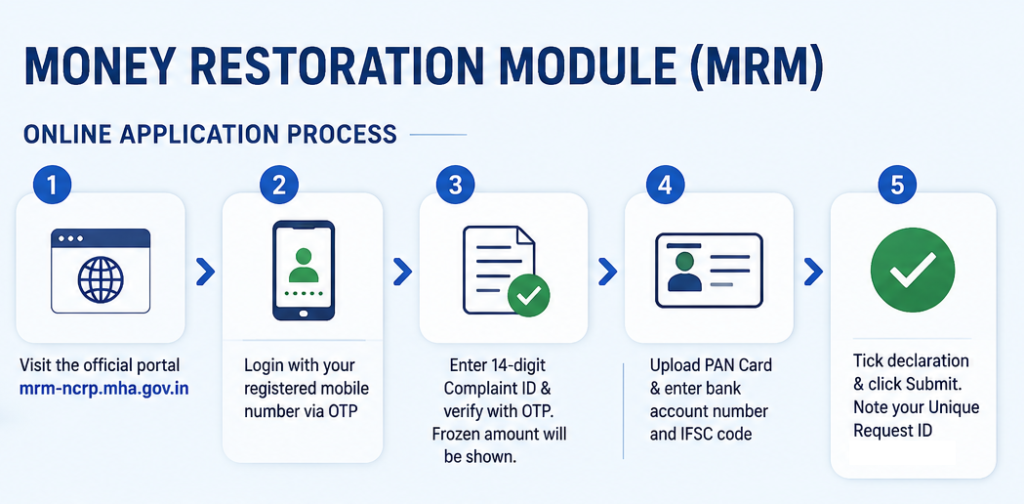
- The process is designed to be simple.
- Visit the official MRM portal at https://mrm-ncrp.mha.gov.in
- Log in using the same mobile number that was used while filing the original cybercrime complaint.
- Select the option to ‘raise a refund request’.
- Enter your 14-digit complaint number and verify it through an OTP.
- If eligible funds have been frozen, the amount should appear on the screen.
- Provide the details of the bank account where you want the refund to be credited. You may also need to upload identification documents such as your PAN card.
- After submitting the application, a unique request ID is generated.
Keep this number safe. It will help you track the status of your request. If you need more help, you can refer to official user manual here.
Three Ways to Getting Money Back
The refund process is divided into three categories based on the frozen amount.
Category 1: Up to Rs. 50,000 frozen in one bank account
If the frozen amount is Rs. 50,000 or less in a single bank account, you do not need to file an FIR or get a court order. The money can be refunded through the MRM portal based on a police report.
Category 2: More than Rs. 50,000 in total, but less than Rs. 50,000 in each account
If the total frozen amount is above Rs. 50,000 but spread across multiple bank accounts, with no single account holding more than Rs. 50,000, you do not need an FIR or court order. The refund can be processed quickly based on the police report.
Category 3: More than Rs. 50,000 frozen in one bank account
If more than Rs. 50,000 is frozen in a single bank account, filing an FIR is mandatory. After the FIR is registered, the remaining refund process can be completed through the MRM portal.
What Happens After You Submit the Request?
After your application is received, the designated police authority reviews the case and uploads the required legal documents through the system.
The concerned bank then processes the restoration based on the approved request and legal provisions.
If everything is in order, the frozen amount is transferred back to your bank account.
The online system is meant to make this process more transparent and easier to monitor.
Don’t Fall for Refund Agents or Middlemen
Whenever a new government service is launched, fraudsters often try to exploit it.
You may come across people claiming they can “speed up” your refund or guarantee recovery in exchange for money.
The refund process is completely free. No private agent, consultant or middleman can legally accelerate the process by charging a fee.
If someone asks for money to help recover your frozen funds, treat it as a warning sign.
The Most Important Lesson: Act Fast
The success of any refund process depends on how quickly the fraud is reported.
Cybercriminals often move stolen money through several accounts within minutes. Every hour of delay reduces the chances of freezing the funds.
If you become a victim of cyber fraud:
Call 1930 immediately or report the incident through the National Cyber Crime Reporting Portal.
Save transaction receipts, screenshots and communication records.
The sooner you report the fraud, the greater the chances that the money can be frozen and eventually restored.
The faster you act, the better your chances of seeing your money again.