Traditional phishing often relied on generic messages sent to thousands of people. AI-powered phishing can create customized messages tailored specifically for you.
You are busy at your work and your phone pings with a notification tone. You see a WhatsApp message asking to urgently pay for your father’s insurance policy as it is expiring today. It also contains a website link of the insurance provider with all the information (Father’s name, home-address, etc.) pre-filled.
As you are checking the details on what seems to be a legitimate website, you receive a phone call from an unknown number. You pick and hear your father’s voice telling you that his phone is not working and he is calling from his friend’s number. He asks you pay for the insurance.
The voice sounds exactly like your father. Everything appears genuine. You proceed to pay.
Congratulations! You have just become on a victim of a newly common AI Phishing scam.
Scammers are using artificial intelligence (AI) to create more convincing scams than ever before.
What Is AI Phishing?
AI phishing is a type of scam where cyber fraudsters use AI tools to create, write, and automate phishing attacks.
Few years ago, phishing attacks relied on poorly written emails filled with spelling mistakes and suspicious links. Who remember those good ol’ Nigerian prince emails?
Today, scammers can now use AI to write personalized messages, imitate voices, and even create realistic video calls to target a specific person.
The goal is still the same as before: trick you into sharing personal information, sending money, downloading malware, or giving access to your accounts.
What has changed is how convincing these attacks can be.
Why AI Phishing Is More Dangerous Than Before?
The emergence of AI tools has given superpowers to scammers.
1. Personalized Messages at Scale
Before AI, writing a targeted phishing email required time and effort. Now a scammer can generate thousands of unique messages within minutes.
A message no longer needs to begin with “Dear Customer.”
It can begin with your name. It can mention your office. It can even appear to come from someone you know.
Normal Phishing:
Dear Customer,
Your bank account has been suspended. Click here immediately to verify your details.
AI Phishing:
Hi Parth,
We noticed a login attempt to your company email account from a new device in Pune earlier today. Since you work with Ex Tech Ltd and frequently access Google Workspace services, we need you to verify your identity to prevent temporary account restrictions. Please complete the verification process within the next 30 minutes.
This makes phishing attacks more believable and harder to detect. That is exactly what makes AI phishing dangerous.
2. Perfect Grammar and Natural Language
We have always been told to look for spelling mistakes and awkward wording to detect phishing emails. That advice is becoming outdated.
Modern AI tools can write polished messages that sound professional. A scam message may no longer contain obvious grammatical errors. AI removes many of the mistakes we used to rely on for detection.
3. Voice Cloning
AI can now generate speech that closely resembles a real person’s voice.
With enough audio samples, scammers may create convincing voice messages that appear to come from a family member, colleague, or even government officials and political leaders.
In McAfee survey, 70% of people said they weren’t confident they could tell the difference between a cloned voice and the real voice.
One of the first major AI voice cloning scams happened in 2019 at a UK energy company. An executive received a phone call that sounded exactly like his boss from Germany. Trusting the voice, he quickly transferred USD 243,000 to a supplier’s bank account in Hungary. But the caller wasn not his boss. It was a scammer using AI to perfectly mimic the boss’s voice.
4. Deepfake Videos
Deepfake technology can create realistic videos that make people appear to say things they never actually said.
Deepfake video scams are are becoming increasingly sophisticated and inexpensive.
In 2024, a finance employee at the British engineering company Arup tricked into transferring USD 25 million by scammers on a deepfake video call posing as senior officers of the company. The employee believed he was in meeting with the company’s Chief Financial Officer and other familiar colleagues.
How Would an AI Scammer Find You?
Modern AI tools can gather information that you have already shared publicly online.
Your social media profiles, LinkedIn page, public posts, comments, photos, and even videos can reveal valuable details about you.
AI can identify where you work, what language you speak, your interests, recent activities, and sometimes even your friends, family members, or colleagues.
It can then use this information to create highly personalized messages that feel familiar and trustworthy.
Hi Harsh, I came across your recent article on online scams and wanted to invite you to speak at a digital literacy conference next month. The event details are in the attached document. Let me know your availability.
As you can see in the above message, this message feels relevant and legitimate. Curiosity may tempt you to open the attachment or click the link.
You don’t need to be hacked to be targeted. Sometimes, the information you voluntarily share online is enough for scammers to build a convincing story around you. It is a reminder that your digital footprint has value.
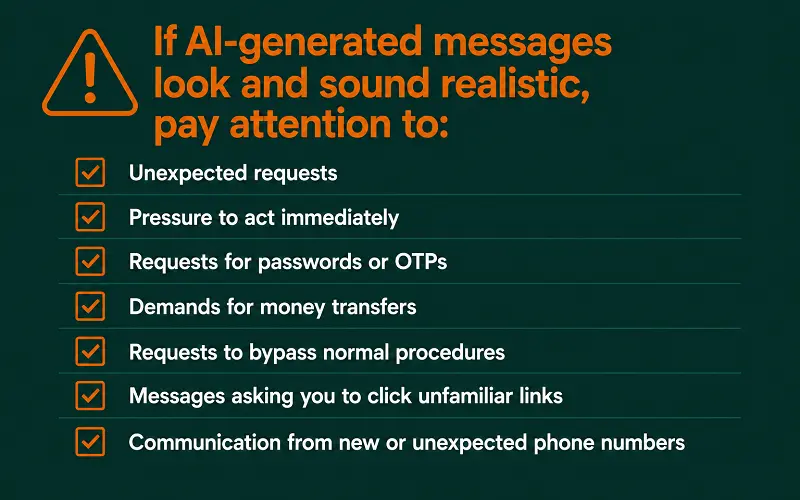
Warning Signs of an AI Phishing Attack
As the old saying goes: If it sounds too good to be true, it probably is.
Sometimes scammers include excessive personal details to gain your trust.
A message that references your workplace, recent activities, or personal interests is not automatically legitimate.
One surprising warning sign is over-personalization.
Sometimes scammers include excessive personal details to gain your trust.
A message that references your workplace, recent activities, or personal interests is not automatically legitimate.
It may simply mean the attacker researched you.
How to Protect Yourself from AI Phishing
The most important habit is simple: Pause. Verify. Then act.
Verify Through Another Channel: If someone requests money, sensitive information, or urgent action, call them directly using a known phone number.
Slow Down: Scammers want you to react quickly. Taking a few minutes to verify a request can prevent costly mistakes.
Limit Public Information: Review your privacy settings and think carefully about what information you share publicly online.
Use Multi-Factor Authentication: Even if credentials are stolen, multi-factor authentication can provide an additional layer of protection.
A few extra seconds of verification can stop an AI-powered scam before it succeeds.