A message appears in a WhatsApp group.
“URGENT! Share this with everyone you know.”
There is a warning about a dangerous product, a new government rule, a missing person, a celebrity death, a political statement or some shocking incident that supposedly happened nearby.
Within minutes, someone forwards it.
Then another person does the same.
Soon, the message has travelled through dozens of groups and social media accounts. By the time someone asks, “Is this actually true?”, the information has already reached thousands of people.
This is one of the defining characteristics of misinformation today.
False or misleading information does not necessarily spread because someone deliberately planned a massive deception. Very often, it spreads because ordinary people react to it in very ordinary ways.
They are worried.
They are angry.
They are surprised.
They want to help.
Or they simply want to be the first person in their group to share something interesting.
Understanding misinformation therefore requires us to look beyond the question, “Why do people believe fake news?”
We need to ask a more uncomfortable question:
Why do we share information before we know whether it is true?
The Emotional Shortcut
Think about the last piece of content that made you immediately stop scrolling. It probably wasn’t an ordinary sentence explaining a routine event. It was something emotionally powerful.
A shocking photograph. An outrageous statement. A frightening warning. A heartwarming story. An accusation. A joke. Emotion is one of the strongest drivers of attention. When something triggers a strong emotional response, we are more likely to remember it and more likely to react to it.
Misinformation often takes advantage of this. A carefully written false post might not say, “Here is an inaccurate piece of information.” Instead, it might say:
“Look what they are hiding.”
“Nobody is talking about this.”
“Please share before this gets deleted.”
“Forward this to save someone’s life.”
These phrases are not accidental.
They create urgency and encourage people to act before thinking.
Confirmation Bias: We Don’t Always Want to Be Corrected
One of the biggest challenges in media literacy is confirmation bias.People tend to give more attention to information that supports what they already believe.This happens across political, social, cultural and even everyday issues.
Suppose someone already believes that a particular public figure is dishonest. They see a post claiming that the person has been caught in a major scandal. They may immediately believe it. Another person who strongly supports that same figure may dismiss the exact same post as fake. Neither person necessarily checked the evidence.
Instead, their existing beliefs influenced how they interpreted the information. This is important because misinformation does not always need to convince people of something completely new.
Sometimes, it simply tells people what they already want to hear.
The “Everyone Is Sharing It” Effect
Another reason misinformation spreads is social proof. When we see hundreds or thousands of people sharing something, we naturally assume that someone must have checked it. But popularity is not evidence.
A false claim can go viral. A truthful claim can receive very little attention.
Virality tells us something about how content is performed on a platform. It does not tell us whether the content is accurate. This distinction is particularly important on social media, where algorithms are designed to identify content that generates engagement. A misleading post that makes people angry may receive thousands of comments. A carefully researched explanation may receive a fraction of that attention. The algorithm sees engagement. It does not necessarily understand truth in the same way a human investigator does.
Why WhatsApp Makes Verification Difficult
Messaging platforms create a particularly difficult environment for misinformation. On an open social media platform, users may be able to inspect an account, view its previous posts or search for the original source. On private messaging platforms, the chain of transmission can become almost invisible.
You receive a message from someone you trust. They received it from someone they trust. That person received it from someone else. Eventually, nobody knows where the information originally came from. Yet because it has travelled through trusted relationships, it feels trustworthy.
This is sometimes called the trust chain.
The information may have no reliable source at the beginning, but every person in the chain assumes that someone else has verified it. That assumption can allow misinformation to travel extremely quickly.
The Forwarding Habit
There is also a cultural element to misinformation. Many people grew up in an environment where forwarding useful information was considered a good thing. If someone shared a health warning, job opportunity, scholarship announcement or emergency message, forwarding it seemed responsible.
Digital communication has simply made this habit faster. But speed changes the consequences. A rumour that might once have taken days to travel through a neighbourhood can now reach millions of people within hours. The solution isn’t to stop sharing useful information.
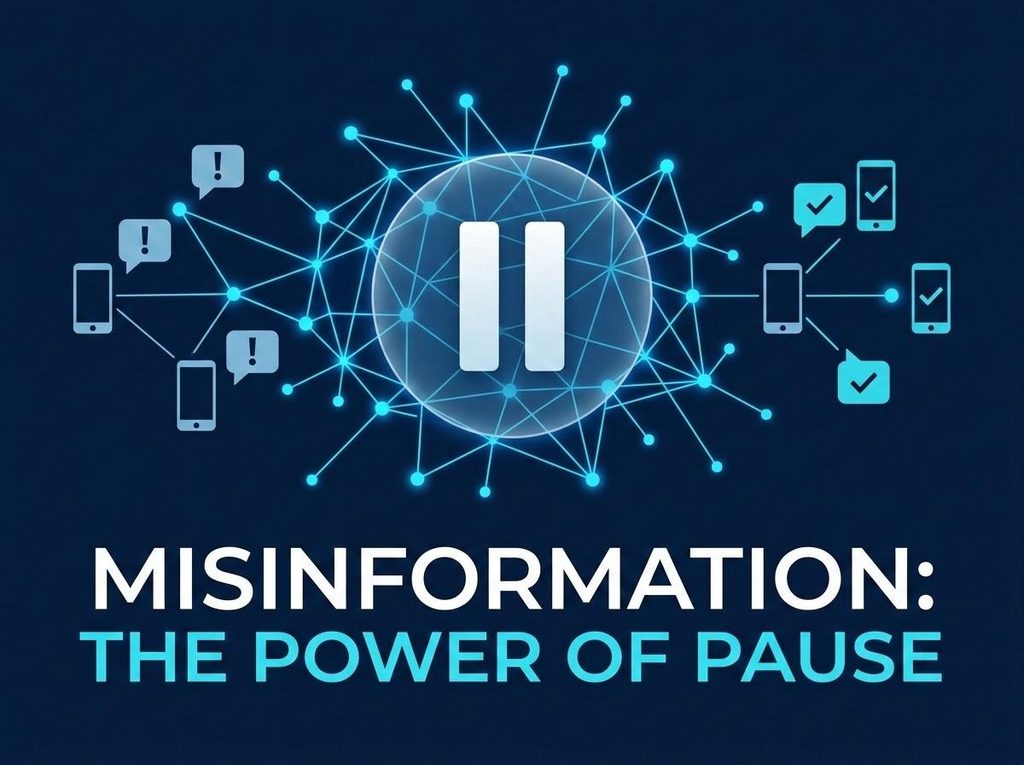
It is to introduce a pause between receiving and forwarding. That pause can be as short as thirty seconds.
Where did this come from?
Is there a date?
Is the source identifiable?
Can I find the same information somewhere else?
If I cannot answer these questions, perhaps I should not forward it yet.
Why Corrections Often Arrive Too Late
One of the frustrating things about misinformation is that correcting it can be much harder than creating it. A false claim can be communicated in one sentence. Correcting it may require several paragraphs of explanation.
For example:
“New rule bans X from next week!”
That’s easy to understand and easy to share.
A fact-check might need to explain the actual regulation, its date, the difference between the proposed rule and the final rule, and where the confusion originated.
The false claim is simple.
The truth is sometimes complicated.
This is one reason media literacy cannot rely only on fact-checking after misinformation has already spread. People also need the skills to evaluate information before they share it.
The Five-Question Pause
A useful media literacy habit is to develop a simple verification pause.
Before sharing a surprising claim, ask five questions:
1. Who is the original source?
Not who forwarded it to you. Who originally made the claim?
2. What is the evidence?
Is there a document, recording, official statement or credible reporting?
3. When was this published?
Old information is frequently recycled as new information.
4. Can I find independent confirmation?
Look beyond the post itself.
5. Why does this content want me to react immediately?
Urgency is not automatically a sign of misinformation, but it is a good reason to slow down.
These questions are simple enough to teach to school students, senior citizens, journalists, community workers and everyday social media users.
The Role of Media Literacy Is Not to Make Everyone a Fact-Checker
There is sometimes a misunderstanding about media literacy. People assume that becoming media literate means learning complicated investigative techniques, reverse image searches or advanced OSINT tools.
Those skills are valuable, especially for journalists and professional fact-checkers. But media literacy begins much earlier.
It begins with recognising that information can be incomplete, manipulated or presented without context. It means knowing that a screenshot is not automatically proof. It means understanding that a blue tick or large follower count does not guarantee accuracy. It means recognising that an emotional reaction can be a reason to pause rather than a reason to share.
Most importantly, it means being comfortable saying:
“I don’t know if this is true yet.”
That sentence is surprisingly powerful.
We Need to Make Verification Socially Acceptable
There is another problem that rarely receives enough attention. In many social groups, questioning information can feel uncomfortable. If an elderly family member forwards something, younger members may hesitate to challenge it.
If a colleague shares a political claim, someone may avoid asking for evidence because they don’t want an argument. If a friend sends a dramatic story, replying “Is this verified?” may feel unnecessarily sceptical.
We need to change that culture. Verification should not be seen as an attack on the person who shared something. It should be seen as a normal part of responsible communication.
Instead of saying:
“That’s fake.”
We can say:
“Let’s check the original source first.”
Instead of:
“You’re spreading misinformation.”
We can say:
“Do we have a reliable source for this?”
Small changes in language can make media literacy easier to practise.
Being Wrong Is Not the Biggest Problem
Everyone will believe something inaccurate at some point. Journalists make mistakes. Experts make mistakes. Governments make mistakes. Fact-checkers make mistakes. Ordinary social media users make mistakes. The goal of media literacy is not to create people who are never fooled.
That is unrealistic.
The goal is to create people who are less likely to spread something they haven’t verified and more willing to correct themselves when new evidence appears.
That is a much healthier definition of information literacy. In the end, misinformation is not just a technology problem. It is a human behaviour problem. It spreads through our emotions, our relationships, our assumptions and our habits. The most effective response therefore cannot simply be another fact-checking website or another warning label.
It has to be a change in behaviour.
Pause.
Question.
Verify.
Then share.
In an internet where anyone can publish information and almost anything can go viral, those four steps may seem insignificant.
They aren’t.
Sometimes, the difference between a rumour reaching ten people and reaching ten million begins with one person deciding not to press “Forward” just yet.